What is NIR spectroscopy?
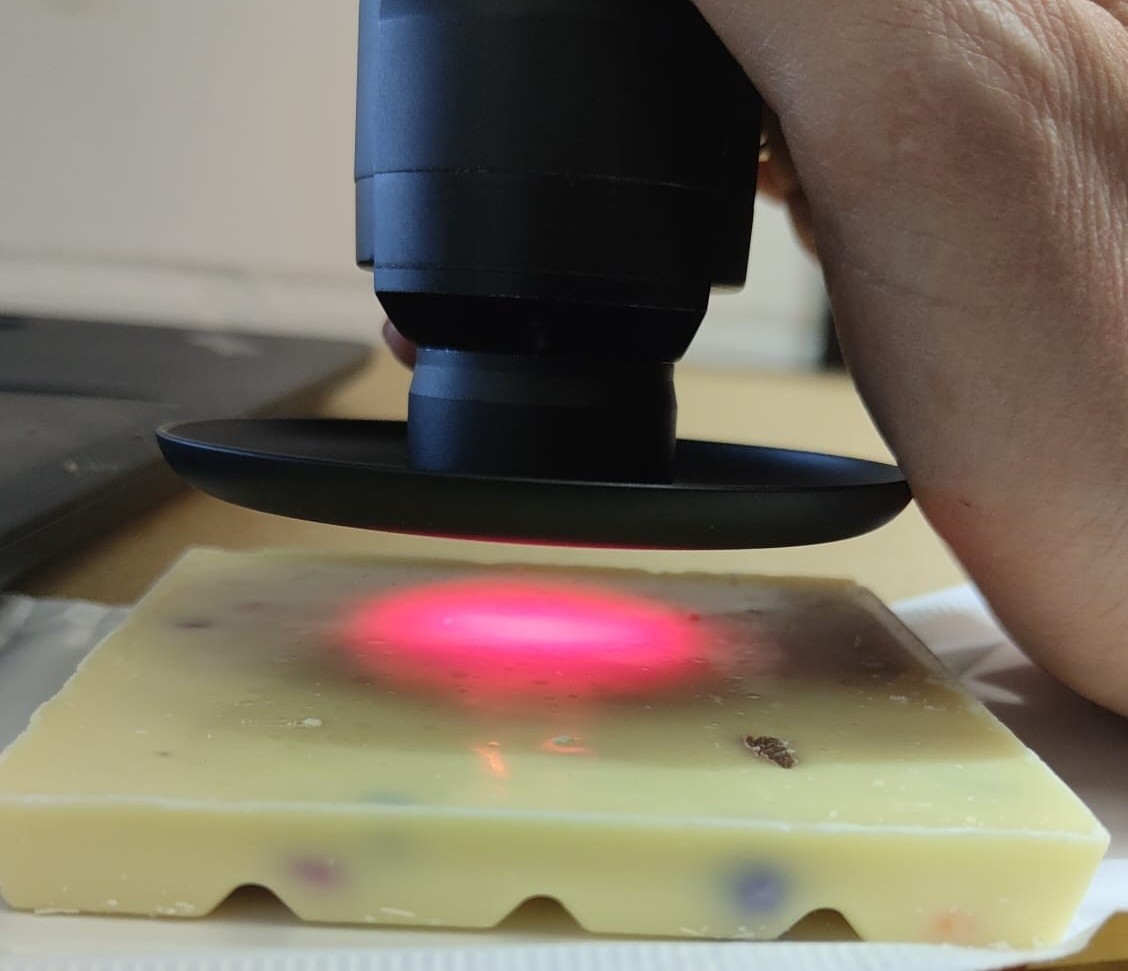
At Vibralytics, we use Near-Infrared (NIR) spectroscopy and chemometrics to analyse food and biological materials and to obtain quantitative and qualitative information about their composition and properties.
NIR stands for Near-Infrared Spectroscopy. It is an analytical technique based on the interaction between near-infrared radiation and matter. The NIR region extends approximately from 780 to 2500 nm, between the visible and mid-infrared regions of the electromagnetic spectrum.
When NIR radiation interacts with a sample, specific wavelengths are absorbed according to the molecular composition of the material. NIR absorption bands originate predominantly from overtones and combination bands of fundamental molecular vibrations, particularly vibrations associated with O–H, C–H, and N–H bonds. These chemical bonds are present in major food constituents such as water, lipids, proteins, and carbohydrates.
The resulting spectrum contains information related to the chemical composition of the sample. However, NIR spectra are characterised by broad, overlapping absorption bands, meaning that individual constituents generally do not produce isolated, uniquely identifiable peaks. Instead, the analytical information is distributed across multiple wavelengths.
This is why chemometrics is an essential component of quantitative NIR analysis.
Chemometrics applies mathematical and statistical methods to multivariate spectral data. Spectral preprocessing, exploratory analysis, calibration, classification, variable selection, and model validation are used to establish relationships between the measured NIR spectra and reference measurements or properties of interest.
Once a model has been calibrated and validated, a new NIR spectrum can be processed by the model to obtain a predicted value or classification. For example, NIR spectroscopy can be used to predict moisture, protein, fat, sugar, or other defined quality parameters, depending on the sample, reference method, spectral range, experimental design, and calibration model.
NIR measurements are also suitable for rapid and non-destructive analysis, with applications ranging from laboratory measurements to at-line, on-line, and in-line process monitoring.
At Vibralytics, we combine NIR spectroscopy, experimental design, and chemometrics to transform spectral measurements into validated analytical models for real-world food applications.
Explore our use cases to see how NIR spectroscopy and chemometrics can be applied to real analytical problems.